

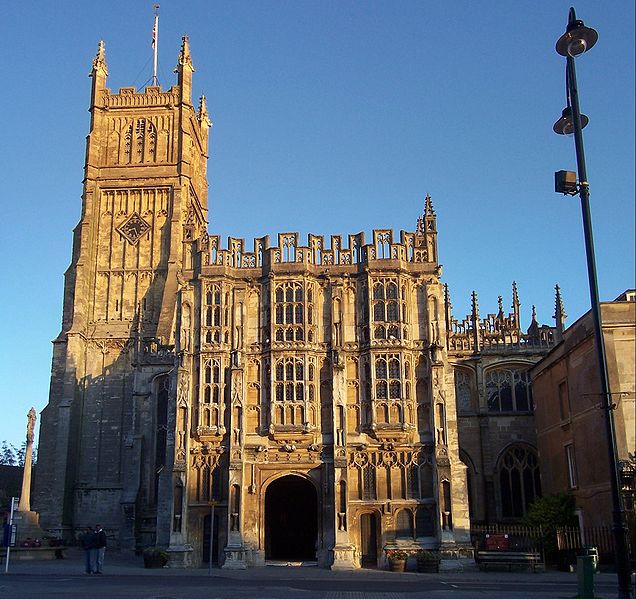
Our next concert on Saturday 23rd March, is at the magnificent St John the Baptist Church in the picturesque, Cotswold wool town of Cirencester. While we make a bi-annual trip to sing at nearby Bingham Hall, this time we are delighted to be invited by the newly formed (2009) Cirencester Male Voice Choir to sing with them in one of the largest Parish Churches in England. They have just returned from The Riviera competition in Torquay winning the prize for the ‘Happiest Choir’. Risca MVC won the singing competition with Bridgend coming a close second. To find out more about Cirencester Male Voice Choir, please click on the link http://www.cirencestermvc.co.uk/concerts.html The choir programme will be augmented by guest soprano Erin Hughes who among many achievements has performed with the English Touring Opera and both choirs will combine with about 100 voices at the end of the concert.
The historic, medieval church of St John the Baptist built around 1100, is renowned for its perpendicular porch, fan vaults and merchants’ tombs.
The chancel is the oldest part of the church started around 1115 and widened in about 1180. The east window dates from around 1300 but the original stained glass of the east window has long since disappeared and it is now filled with fifteenth century glass from other parts of the church.
To the north of the chancel is St. Catherine’s Chapel which dates from around 1150. It contains a wall painting of St. Christopher carrying the Christ Child, and vaulting given by Abbot John Hakebourne in 1508.
To the north of St. Catherine’s Chapel is the Lady Chapel, first built in 1240 and extended in the 15th century.
The Trinity Chapel dates from 1430–1460 and was endowed for a priest of the nearby Abbey to say masses for the souls of Kings and Queens. It contains a squint which enabled the priest to synchronise the celebration of mass with that at the high altar. The nave was completely rebuilt between 1515 and 1530 and is a remarkable example of late perpendicular gothic architecture.
The tower is fifteenth century and remarkable for the large buttresses which shore it up at its junction with the nave and the great south porch which adjoins the market place and was built around 1500 at the expense of Alice Avening.
In a small recess at the east end of the south aisle is a silver goblet. This is the Anne Boleyn cup, so named because it was given by Queen Anne Boleyn to Dr Richard Masters, physician, in thanks for his care of Anne’s daughter, the future Elizabeth I. It was presented by Dr Masters to the church in 1561. The cup is gilt silver.