

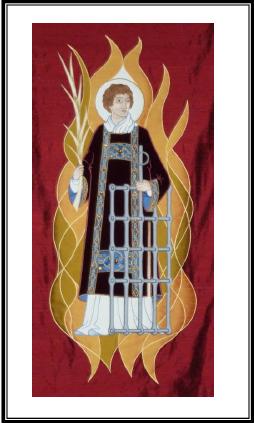
On Saturday 2nd March the Choir is travelling to the historic Cotswold town of Stroud to sing at the restored St Laurence Church, the Parish church of the town. Among the pieces to be sung are Laudamus, Innsbruck and the 23rd Psalm – all in Welsh. That should surprise the locals, but we are a Welsh Male Voice Choir after all! The concert starts at 7-00pm and is in aid of Stroud Lions International.
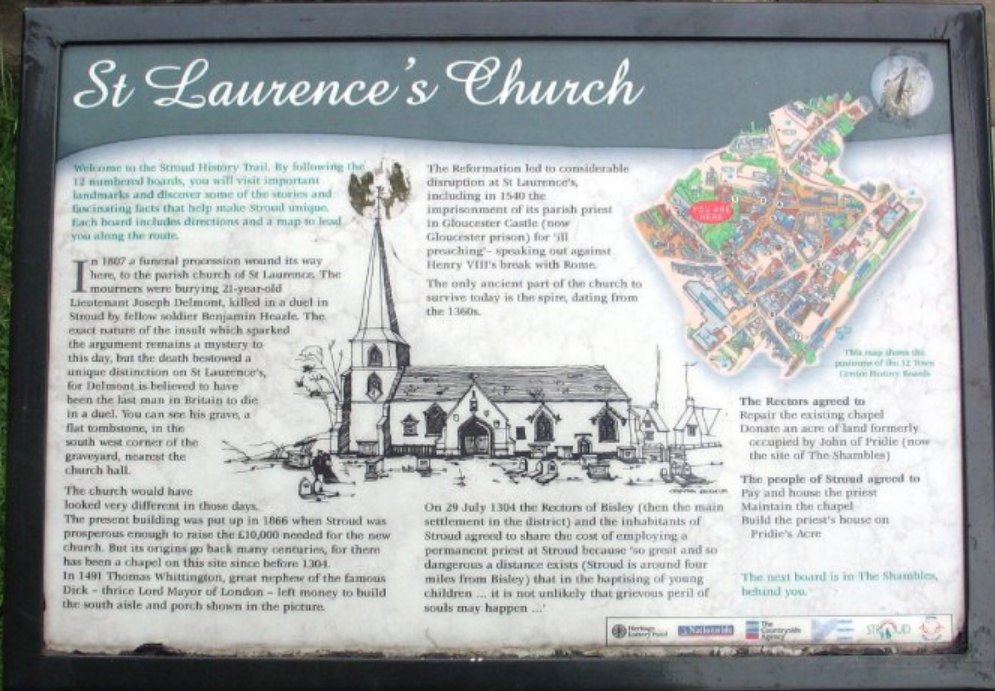
In medieval times, a church was built on this site as a chapel of ease to the mother church of St Mary’s, Bisley.
By the 14th century, Stroud had grown to the extent that it could have its own priest.
In the 19th century, it was felt that the church was not large enough for the congregations of the day and so in 1866 the whole church – with the exception of the tower and spire – was pulled down and the new building was consecrated and re-opened for worship in 1868.
Therefore what one sees on entering the church is essentially the Victorian structure.
On the wall in the south aisle are some pictures of the “old” church.
There are also some items that were saved from that church, mainly in the form of memorial tablets. They were placed on the west wall of the nave and in the ringing chamber in the tower. One of the tablets by the door into the tower commemorates the Fisher family, including Paul Hawkins Fisher who wrote, in the 19th century, a very full and informative history of Stroud entitled
Notes and Recollections of Stroud.
The most striking monument rescued from the old church is now in the south transept. It shows Thomas Stephens of Lypiatt in his lawyers robes. He was attorney general to both Henry and Charles Stuart. Charles later became King Charles II.
The church contains a number of features donated in memory of members of the Stanton family who were prominent citizens in a number of fields including cloth manufacture and politics, some representing Stroud in Parliament. The magnificent wooden screen between the nave and the choir was donated in 1912 by the Stanton family, and the cross above it was added in 1914 in memory of Father Arthur Stanton who served the very poor parish of St Alban’s in Holborn, London for 50 years.